Buying a home while carrying student loan debt can feel challenging, especially when you are…
Can Veterans Use an FHA Loan if VA Financing Is Not the Right Fit?
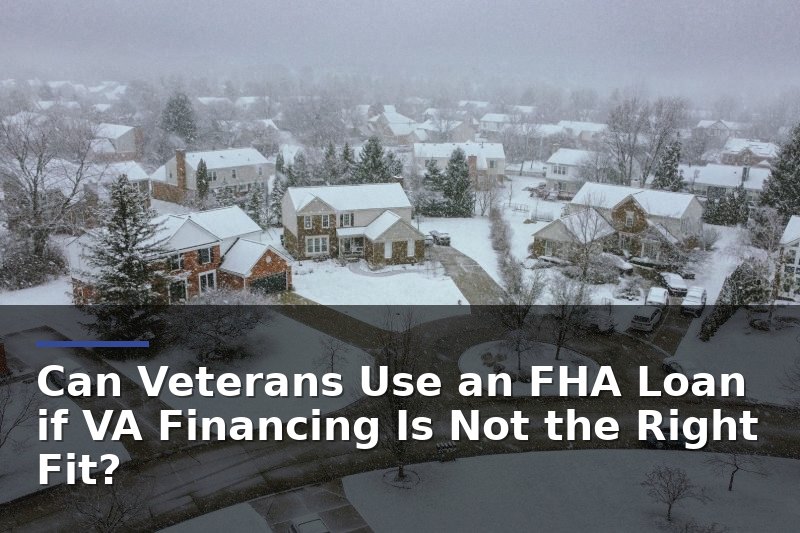
Veterans may qualify for VA financing, but there are situations where a VA loan may not be the right option for a specific purchase. Yes, an eligible Veteran can use an FHA loan instead of a VA loan, provided the borrower, property, and transaction meet current FHA requirements. In this guide, we’ll explain why a Veteran may consider FHA financing, how FHA and VA loans compare, and what to review before making a decision.
Key Takeaways
- Eligibility: VA eligibility does not prevent a Veteran from choosing an FHA loan.
- Down Payment: FHA financing generally requires at least 3.5% down for qualifying borrowers, while eligible VA borrowers may be able to finance a purchase with no down payment.
- Mortgage Insurance: FHA loans generally include upfront and annual mortgage insurance, while VA loans do not have monthly mortgage insurance.
- Property Use: Both FHA and VA purchase loans generally require the home to be used as the borrower’s primary residence.
- Best Fit: The right program depends on the property, available funds, loan amount, eligibility, and the borrower’s overall financial scenario.
Quick Answers
- Can an eligible Veteran choose FHA financing? Yes. Veterans are not required to use their VA home loan benefit.
- Does an FHA loan use VA entitlement? No. An FHA loan does not use or reduce a borrower’s available VA entitlement.
- Does FHA offer a zero-down purchase option? Generally, no. FHA commonly requires a minimum down payment of 3.5% for qualifying borrowers.
- Must an FHA-financed home be a primary residence? Yes. FHA purchase financing is intended for owner-occupied primary residences, subject to program guidelines.
At Blue Door Mortgage (NMLS# 2218), we help Veterans compare available programs and understand the costs, requirements, and tradeoffs. Our goal is to provide straight answers and help each borrower make an informed decision based on the details of the transaction.
Why Would a Veteran Consider an FHA Loan?
A VA loan can provide valuable benefits, including a possible zero-down purchase and no monthly mortgage insurance. However, the availability of a VA benefit does not automatically mean that a VA loan will fit every property or transaction.
A Veteran may consider an FHA home loan for several reasons:
- The borrower has VA entitlement tied to another property.
- The borrower wants to preserve available entitlement for a future purchase.
- The property meets FHA eligibility requirements but does not meet the applicable VA requirements.
- The borrower’s specific credit, debt, or income profile works differently under FHA guidelines.
- A condominium project has FHA eligibility but does not meet the applicable VA project requirements.
- The FHA loan structure produces a more workable option after all costs are compared.
These situations do not mean that FHA is automatically better than VA. They mean that the programs should be compared based on the actual purchase contract, property, qualifications, and long-term plans.
FHA Loans and VA Loans Have Different Structures
FHA loans are insured by the Federal Housing Administration, while VA loans are guaranteed in part by the U.S. Department of Veterans Affairs. The programs have separate eligibility rules, fees, appraisal processes, and property requirements.
| Feature | FHA Loan | VA Loan |
|---|---|---|
| Borrower Eligibility | Available to borrowers who meet FHA and lender requirements | Limited to eligible Veterans, service members, and certain surviving spouses |
| Minimum Down Payment | Generally 3.5% for qualifying borrowers | May allow zero down, subject to entitlement, qualifications, and property value |
| Mortgage Insurance or Program Fee | Upfront and annual mortgage insurance generally applies | No monthly mortgage insurance; a VA funding fee may apply unless the borrower is exempt |
| Occupancy | Primary residence generally required | Primary residence generally required |
| Loan Limits | FHA limits vary by county and property type | Entitlement and lender requirements may affect the structure |
| Appraisal | FHA appraisal and minimum property standards apply | VA appraisal and minimum property requirements apply |
Rates, fees, insurance costs, and qualification requirements can change. The comparison should be based on current guidelines and the borrower’s individual scenario.
FHA Financing Does Not Affect VA Entitlement
Using an FHA loan does not use a Veteran’s VA entitlement. VA entitlement is connected to VA-guaranteed financing, not FHA financing.
This can matter when a Veteran already has a VA loan on another property or wants to keep the VA benefit available for a future purchase. However, preserving entitlement should not be the only consideration. The down payment, monthly payment, mortgage insurance, closing costs, and future plans should all be reviewed.
Veterans who are uncertain about their available benefit can review the general VA loan eligibility requirements. A Certificate of Eligibility can help document entitlement, but it does not by itself provide loan approval.
How FHA Mortgage Insurance Changes the Cost
One of the most significant differences between FHA and VA financing is mortgage insurance. FHA loans generally require both an upfront mortgage insurance premium and an annual mortgage insurance premium collected through the monthly payment.
The cost varies based on the loan structure and current FHA rules. Depending on the original down payment, FHA mortgage insurance may remain for an extended period or for the life of the loan unless the borrower later refinances into another eligible program.
VA loans do not have monthly mortgage insurance, although a VA funding fee commonly applies. Some eligible Veterans are exempt from that fee. Because these costs work differently, comparing only the interest rate will not provide the full picture.
Compare the Total Monthly Payment
A useful comparison includes:
- Principal and interest
- Property taxes
- Homeowners insurance
- FHA mortgage insurance, if applicable
- Homeowners association dues, if applicable
- The estimated cash needed at closing
A lower down payment can preserve cash, but it may also increase the loan balance and monthly cost. We recommend reviewing both the short-term cash requirement and the longer-term expense.
Credit, Income, and Debt Requirements May Differ
FHA and VA loans both require lenders to evaluate credit, income, assets, employment, and existing debts. The way each program evaluates the overall file can differ.
FHA guidelines may provide flexibility for some credit profiles, but FHA approval is not automatic. A lender may also apply an overlay, which is an additional requirement beyond the minimum agency or program guideline.
Program eligibility and lender approval are not the same thing. A borrower may meet a general FHA guideline but still need to satisfy the lender’s documentation, credit, or risk requirements.
Self-employed borrowers may need personal and business tax returns, year-to-date financial statements, business bank statements, or other documentation. The exact requirements depend on the business structure, ownership percentage, income history, and underwriting findings.
The Property Must Also Qualify
Loan approval involves both borrower eligibility and property eligibility. An FHA loan cannot be used simply to avoid all property-related requirements.
FHA and VA appraisals both evaluate value and certain health, safety, and property conditions, although their standards and procedures are not identical. If a home needs significant repairs, standard FHA financing may not solve the issue.
In that situation, a borrower may need to discuss repairs with the seller or explore a renovation loan option. Renovation financing has additional contractor, appraisal, budget, and project requirements, so it should be reviewed early.
Condominium Eligibility
Condominiums can require an additional level of review. FHA and VA maintain separate project eligibility standards, and a project that works for one program may not work for the other.
Condominium approval can depend on insurance, ownership information, project finances, litigation, commercial space, and other factors. The lender should review the project as early as possible, especially in areas such as Boston, Brookline, Newton, and other Massachusetts communities where condominium purchases are common.
Steps for Comparing FHA and VA Financing
- Confirm VA eligibility and entitlement. Obtain the available VA documentation so the comparison is based on accurate information.
- Review the purchase price and property type. Loan limits, condominium requirements, occupancy, and appraisal standards can affect the options.
- Compare cash needed at closing. Include the down payment, closing costs, prepaid expenses, and any program fees.
- Compare the full monthly payment. Include mortgage insurance and association dues rather than focusing only on principal and interest.
- Review long-term plans. Consider how long the borrower expects to own the property and whether a future refinance may be appropriate.
- Verify current guidelines. FHA, VA, and individual lender requirements can change, so the final comparison should use current information.
Planning Before Making an Offer
A pre-approval review can identify whether FHA, VA, conventional, or another option is more appropriate before a purchase contract is signed. It can also help uncover property restrictions, documentation needs, or entitlement questions early in the process.
For a Massachusetts purchase, local property values and county loan limits may also affect the analysis. This can be especially relevant for move-up buyers or borrowers considering higher-priced homes in Wellesley, Newton, Brookline, or Boston.
We are ready to review the purchase price, available funds, credit, income, entitlement, and property type with professionalism. Please call, text, or email us to compare the options and understand the next steps. Jonathan White, President (NMLS# 3443), and our team can also help with pre-approval planning based on the details of the scenario.
Frequently Asked Questions
Can a borrower switch from VA to FHA financing after making an offer?
A borrower may be able to change loan programs, but the lender, real estate professionals, and other involved parties should be notified promptly. A change can affect the appraisal, financing dates, contract terms, closing costs, and required documentation.
Can gift funds be used toward an FHA purchase?
FHA guidelines generally allow eligible gift funds from acceptable sources for the down payment or closing costs. The gift must be documented, and lender requirements may apply to the donor, transfer of funds, and supporting bank records.
Can a Veteran use FHA financing to purchase a condominium?
Yes, if the borrower and condominium meet applicable FHA requirements. The project may need FHA approval or may qualify for another permitted review process, depending on current guidelines and lender requirements.
Can a non-Veteran spouse or co-borrower be included on an FHA loan?
FHA financing may allow an eligible spouse or other co-borrower to apply, subject to occupancy, credit, income, and underwriting requirements. This differs from VA financing, where the type of co-borrower can affect the available loan structure and required down payment.
Can an FHA loan be refinanced into a VA loan later?
An eligible Veteran may be able to refinance an FHA loan into a VA loan if current VA, lender, property, and qualification requirements are met. Closing costs, the VA funding fee or exemption status, available equity, and the financial benefit should be reviewed before proceeding.
This is educational and not financial advice. Loan programs and guidelines can change. Talk with a licensed mortgage professional about your specific scenario.

About the Author
Jonathan White
President at Blue Door Mortgage · NMLS #3443
I am the President and one of the producing Mortgage Brokers for Blue Door Mortgage located in Brookline, Massachusetts. With over 29 years in the Mortgage Brokerage business, I have helped thousands of homeowners and generations of their families with the purchasing and refinancing of their properties.
Specializes in: Conventional, FHA, Jumbo
Licensed in: FL, MA, NH, RI
Related Posts